

More
U.S. WOMEN'S OPEN
Sixth Sense: Riviera Country Club’s Unique Par 3

Sixth Sense: Riviera Country Club’s Unique Par 3
“When you play a course and remember each hole, it has individuality and change. If your mind cannot recall the exact sequence of the holes, that course lacks the great assets of originality and diversity.” – George Thomas Jr.
Since the first courses took shape in the 1600s, architects have found different ways to challenge golfers through various design concepts.
Charles Blair Macdonald, considered the “Father of American Golf Course Architecture,” incorporated template holes from the classic layouts found in Great Britain, from the Redan at North Berwick to Eden at the Old Course to the Alps found at Prestwick. Such philosophies were passed down from Macdonald to successors Seth Raynor and Charles Banks and can be found on virtually every course designed by this trio.
When Philadelphia native George Thomas ventured out to California to work on several designs that would become the iconic trio of Bel-Air Country Club, The Los Angeles Country Club and The Riviera Country Club, he decided not to follow the lead of Macdonald and create templates.
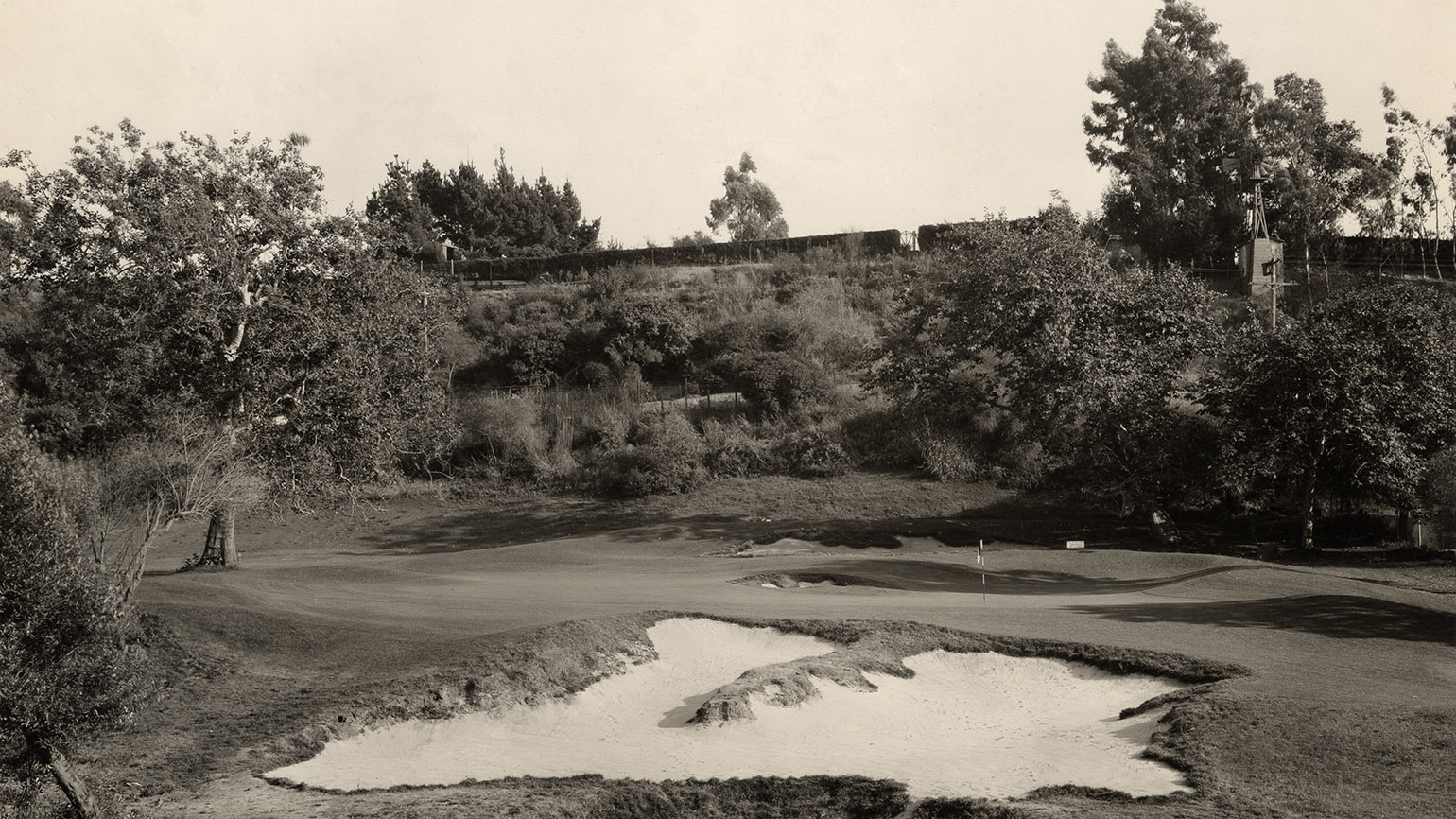
The sixth at Riviera, site of this year’s U.S. Women’s Open Presented by Ally, is pure proof of Thomas’ unorthodox approach to a par 3. Placing a bunker in the middle of a green complex was not something architects had tried before Riviera officially opened for play in 1926.
As Golf Digest architecture editor Ron Whitten, co-author of “The Architects of Golf” with Geoffrey Cornish, said in “The Riviera Country Club: A Definitive History” by Geoff Shackelford, “In the field of golf design, where imitation is passed off as inspiration, a truly original hole is as rare as an amateur architect. Which makes the sixth at Riviera all the more remarkable. It was a true original, created by a genuine amateur designer.”
So why did Thomas decide to place a bunker within the green complex on a hole that will measure 164 yards for the championship?
According to Whitten, the architect wanted to eliminate the obvious target, the center of the green. Placing a bunker made the golfer concentrate on the upcoming tee shot, requiring precision over pragmatism. With the long par-3 fourth and the challenging par-4 fifth, the sixth comes at a portion of the round that promotes finesse and faith over brute strength.
What also makes the hole unique is that few architects have mimicked the design. When Greg Norman created TPC San Antonio, he incorporated such a bunker on the 16th hole of the Oaks Course, the venue used for the PGA Tour’s annual Valero Texas Open.
Riviera’s sixth is seen each year when the Genesis Open (formerly the Los Angeles Open) comes to town. The 2026 U.S. Women’s Open will be the first major women’s event contested on Thomas’ masterpiece. It previously hosted the 1948 U.S. Open (Ben Hogan), 1998 U.S. Senior Open (Hale Irwin) and 2017 U.S. Amateur (Doc Redman).
The sixth will undoubtedly receive plenty of chatter from the 156 U.S. Women’s Open competitors, along with several other interesting holes, including the short 10th, considered by some to be one of the best drivable par-4s in the world.
Of course, such a unique green complex limits the number of hole locations that can be used over the course of a competition. Shannon Rouillard, who oversees course setup for the U.S. Women’s Open, said holes can only be cut in the short-right and back-left portions of the green. The pitch is too severe for the other two quadrants.
But should a player miss her target and be on the wrong side of the green, that bunker could create some interesting shot options. Players have pitched over the bunker and putted around it, trying to use the contour to their advantage.
Whitten wrote in Shackelford’s club history: “Thomas himself was rather casual about the unique nature of his creation. The tiny bunker, he once wrote, simply divided the green into two compartments. True enough. Many architects before him divided greens into sections to provide variety. They did so by using plateaus or mounds or troughs. But no one had ever used a [sand] hazard.”
Of course, such a design does create challenges for the maintenance team, which is another reason why so few copycats of the hole exist. “At Riviera, a succession of green committees and superintendents have steadfastly preserved it, obviously recognizing that there is perhaps no more essential hazard on the course,” Whitten wrote.
Such a design philosophy wasn’t copied until Roy Dye, the younger brother of legendary architect Pete Dye, placed bunkers in the middle of a couple of greens. One survived and one didn’t. Eighteen-time major champion and world-renowned designer Jack Nicklaus, in the 1980s, built several horseshoe-shaped greens wrapped around bunkers, creating a boomerang look. But when he designed the White Course at Dismal River, in Mullen, Neb., that opened in 2006, Nicklaus chose to place a bunker in the middle of the par-3 10th hole. Jerry Pate, the 1976 U.S. Open champion, and Tom Sieckmann prescribed bunkers in the center of greens on a couple of their designs.
They were inspired, each said, by what Thomas did with the sixth at Riviera.
David Shefter is a senior staff writer at the USGA. Email him at dshefter@usga.org.

© 2026 United States Golf Association. All Rights Reserved.